Attorney Website Content Writing
Practice-area pages, location pages and the rest of your site, written to be specific, accurate and local, so the right people find you and call.
Get a Custom Quote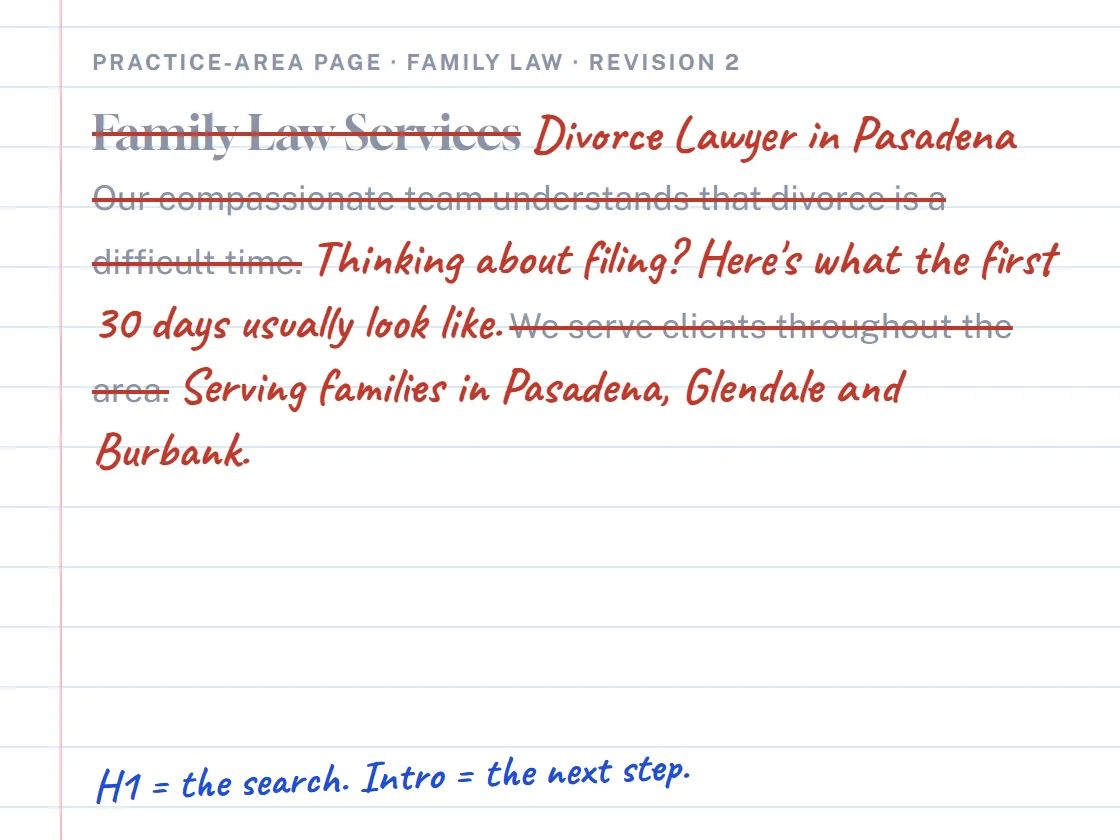
Why it matters
Your practice-area pages do the heavy lifting
When someone searches for a car accident lawyer, a custody attorney or help with a DUI charge, Google usually sends them to a practice-area or location page. Those pages carry most of the weight on a law firm site. On many firm sites, they're also the weakest writing: a few paragraphs about experience and dedication, and a contact button.
I write attorney website content that answers the reader's real question, in their jurisdiction, in plain language. Every page is built around how people search for your services, structured so search engines and AI answer engines can understand it, and checked against the statutes, local rules and bar advertising guidelines that apply to your firm.
Some firms need one page done right. Others need the whole site rewritten or refreshed. I handle both, and you work with me directly the whole way through.
What's included
- Practice-area pages for each case type you handle
- Location and city pages built on real local research
- Homepage, About and Contact pages
- One-off pages or a full-site rewrite or refresh
- Headings, entities and schema structured for search engines and AI answer engines
- Two rounds of revisions, plus optional CMS upload and internal linking
What makes a practice-area page rank?
A page ranks when it's the best answer to the search behind it. For a practice-area page, that usually means a reader who has a problem right now and wants to know three things: can this firm help, what happens next, and what should I do in the meantime. Pages that answer those questions clearly, for the right state and city, give search engines and readers a reason to choose them.
Structure does a lot of the work. Clear headings that match real questions, accurate legal detail, internal links to related pages and schema that describes your firm all help search engines understand what the page covers. The same structure helps AI answer engines like ChatGPT, Perplexity and Google AI Overviews parse your content and cite it.
One more thing gets overlooked: each page needs its own job. When three pages on your site all target the same search, they compete with each other. I group pages into clusters under a strong anchor page so each one supports the others.
What should an attorney's practice-area page include?
Every practice area is different, but strong pages tend to cover the same ground:
- Who the page is for, in the reader's own words
- The key legal points for your state, with deadlines and rules stated accurately
- What the process looks like from the first call to resolution
- Answers to the questions your intake team hears most
- What makes your firm different, using only facts you've approved
- Required disclaimers and a clear next step
Do law firms need separate pages for each city?
If you serve several cities, a page for each can help you show up in those local searches. The catch is that most location pages are thin. They swap the city name and keep everything else the same, and readers can tell.
I use a simple check I call the swap test: replace the city name, and any sentence that still reads true is filler. A real location page talks about the courts, roads, agencies and local rules that matter to people in that area. That takes local research, and I do it for every city page I write.
Not every city needs a page. If you rarely take cases in a town, or the search demand isn't there, a thin page for it can dilute your site more than it helps. I'll tell you which locations are worth a dedicated page and which are better covered on a broader regional page.
Should you refresh old pages or rewrite the whole site?
It depends on what's already working. Before I recommend anything, I grade your existing pages and check which ones already bring in traffic. Pages that rank go on a "Do Not Touch" list so a rewrite never costs you ground you've already earned.
From there, the choice is yours. Some firms start with their two or three most important practice areas and expand. Others want a full-site rewrite so every page speaks with one voice. I'll give you my honest read on which approach makes sense for your firm and your budget.
Old blog posts get the same treatment. Each one is marked keep, update, merge or cut. Merging several thin posts into one strong page often does more for a site than writing something new, and cutting outdated posts keeps readers from finding advice that no longer applies.
How do you keep attorney website content compliant?
Law firm marketing has rules that most marketing doesn't. I review your state's bar advertising and marketing guidelines before I write, and ABA marketing guidelines inform every draft. That means no promised outcomes, careful handling of past results and the disclaimers your jurisdiction expects.
Claims about your firm come only from information you've confirmed. Legal claims are checked against official sources. Your attorneys review and approve every page before or right after it goes live, so the final word on accuracy stays with the people whose names are on the door.
How it works
From audit to live pages
1. Discovery and audit
We talk about your firm, your markets and the cases you want more of. I grade your current pages and flag the ones that already rank so we protect them.
2. Page plan
I map out which pages to write, refresh or leave alone, grouped into clusters so they support each other. You approve the plan before writing starts.
3. Research and writing
I review live search results and local details for each page, check the law in your jurisdiction, and draft. Batches arrive in 5 to 10 business days, with rush available.
4. Review and launch
Two rounds of revisions are included, and your attorneys approve the final copy. I can upload to your CMS and add internal links so the pages are ready to go.
What clients say
Mike · ZD Law "We've made some great jumps in our organic traffic over the last few months, which is in no small part thanks to your support. Thank you!"
Jeremy O. · Director of Content Strategy "Brandon was a freelance writer for our team for several years. He was a fantastic contributor, always reliable, taking on extra assignments, meeting deadlines, and submitting quality work."
Fred B. · Effir Media "It was a pleasure working with Your Legal Content Writer. They brought a lot of value to the project and gave really sound advice from an SEO perspective."
Lauren · IntelliShift "Brandon is so great at transforming a website's content! He's super easy to work with and delivers high-quality work so quickly! Highly recommend!"
Questions
Attorney website content FAQ
Can you rewrite pages that already rank?
Carefully, and only when it makes sense. Pages that already bring in traffic go on a "Do Not Touch" list. If one of them needs an update, I make targeted changes and leave alone what's working.
How long does a full-site rewrite take?
I deliver in batches, and standard turnaround is 5 to 10 business days per batch of pages. The full timeline depends on the size of your site. Rush delivery is available for an added fee if you're working toward a launch date.
What do you need from us?
Less than you'd think. I'll send a short worksheet covering the case types you take and want more of, your markets, what sets you apart and any results you're allowed to mention. Everything I write about your firm comes from that file.
Can you write location pages for cities where we don't have an office?
Often, yes, as long as the page is honest about where you practice. A page that implies an office you don't have can mislead readers and raise bar advertising issues, so I write those pages around the area you serve and check your state's rules first.
Will the pages sound like our firm?
Yes. I match the tone to your practice and your clients. A family law page calls for empathy and child-centered language. A criminal defense page needs calm, direct reassurance. Two rounds of revisions give you room to fine-tune the voice.
Do our attorneys review the content?
Yes, and I encourage it. Each page comes with notes on the legal claims it makes and where they're sourced, which makes attorney review faster. Your attorneys approve every page before or right after it's published.
Related services
- Blog Subscriptions →Locally focused blog posts on a set schedule, planned around the cases you want more of.
- Newsletters →Monthly or quarterly newsletters that keep your firm top of mind with past clients and the people they know.
- How I write every page →Research, fact-checking against official law, and your sign-off.
Let's talk →
Let's fix the pages that matter most.
Tell me which pages you need, or send your site and I'll tell you where I'd start. I'll reply personally within one business day with a custom quote. No obligation.